
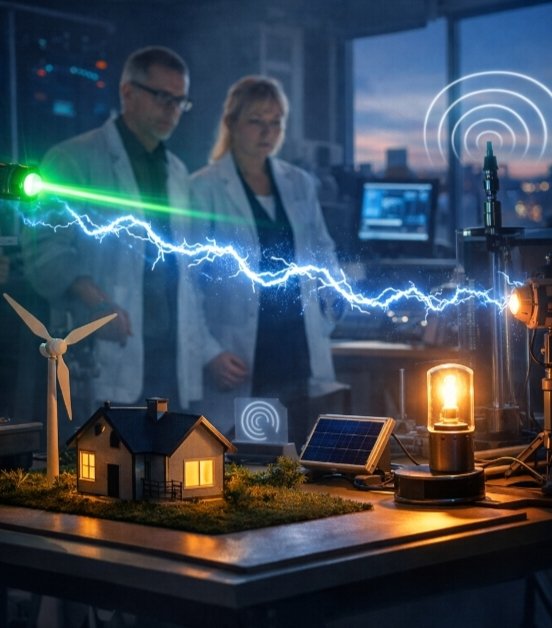
Finland wireless electricity transmission is attracting global attention after social-media posts claimed that the country has achieved the ability to send electricity through the air without traditional cables. While wireless power technology is real and Finnish researchers and companies are working in this field, the viral claim needs some context.
Wireless power transfer uses electromagnetic fields, radio-frequency energy, magnetic resonance or other technologies to move electrical energy from a transmitter to a receiver without a physical electrical connection. Such systems have already been demonstrated for applications including sensors, electronic devices and electric-vehicle charging.
In January 2026, Finnish company Willo Technologies announced a system capable of delivering power wirelessly to devices without requiring precise alignment between the transmitter and receiver. The company said its technology can power multiple moving devices simultaneously, highlighting potential applications for future wireless charging systems.
However, this does not mean Finland has replaced electricity cables or is currently supplying homes and cities with electricity through the air. Existing wireless-power demonstrations generally involve controlled environments, specific receivers and relatively limited distances or power levels. Wireless transmission becomes considerably more challenging as distance and required power increase.
The technology can work in several ways. Resonant inductive coupling uses coils tuned to the same frequency, allowing energy to move across an air gap. Other approaches can use radio waves, microwaves or lasers to transmit energy toward a receiving system.
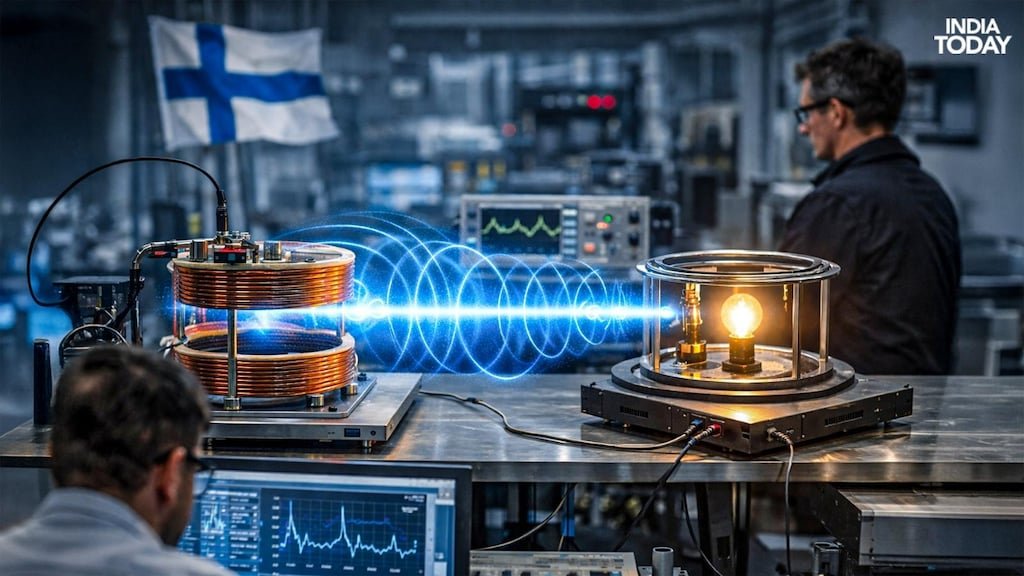
Finland’s work is part of a much broader international effort to develop wireless energy systems. Researchers and companies are exploring potential applications in areas where conventional cables can be difficult to install, including industrial equipment, sensors, remote devices and electric transportation.
The distinction between wireless power transfer and a wireless electricity grid is important. A viral image may suggest that electricity can now simply travel through the atmosphere like Wi-Fi, but current technology does not support replacing conventional national power networks in this way.
Similar research is also taking place elsewhere. For example, Japan’s NTT and Mitsubishi Heavy Industries reported a 2025 experiment that transmitted electrical power optically across a 1-kilometre distance, demonstrating another approach to long-distance wireless power transmission.
Therefore, the Finland story represents an interesting development in wireless power technology, but the claim that Finland has eliminated the need for electricity cables is misleading. The technology remains an area of research and development, with engineers continuing to work on efficiency, distance, safety and practical applications.