
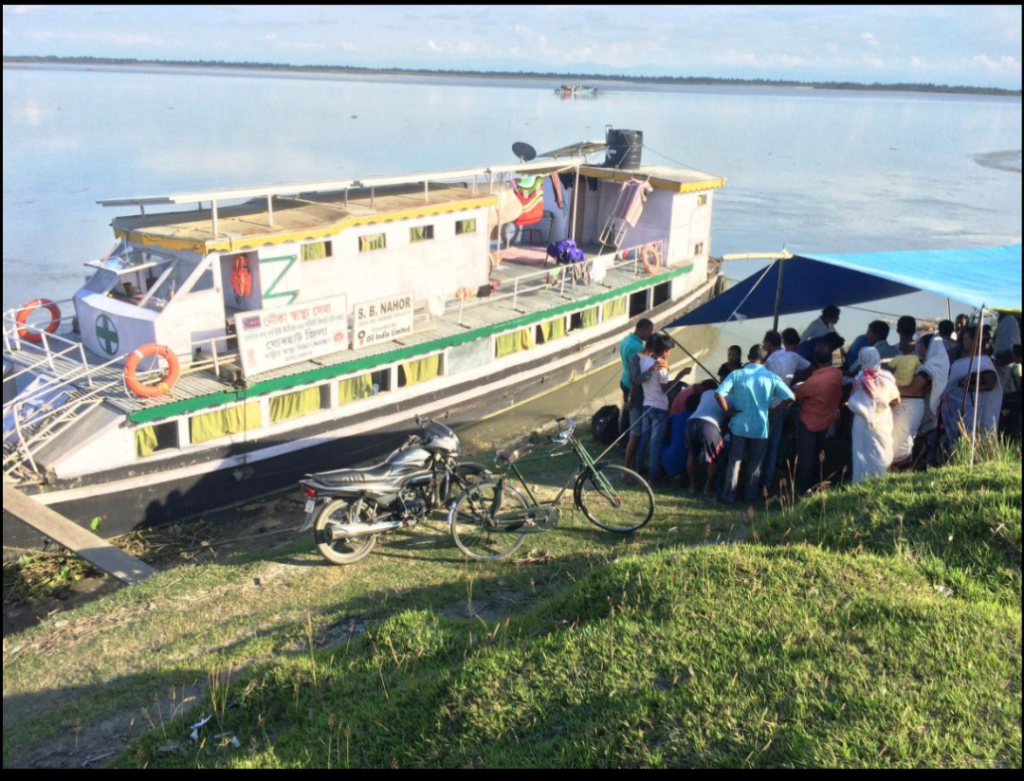
In Assam’s vast network of river islands — known locally as chars or saporis — access to basic healthcare has long been a major challenge. These temporary sandbars and islands along the Brahmaputra are home to more than three million people, many of whom live without roads, permanent health centres or reliable transport.
To bridge this gap, a network of mobile boat clinics has been delivering essential medical services directly to these isolated communities for nearly two decades. The initiative places special emphasis on maternal and infant health.
The programme, often referred to as “Akha” (Assamese for “hope”), began as an initiative of the Centre for North East Studies and Policy Research (C-NES) and was later integrated with the National Health Mission (NHM), Government of Assam.
Today, 15 boat clinic units operate across 13 districts, including Dhubri, Barpeta, Nalbari, Morigaon, Sonitpur, Lakhimpur, Dhemaji, Dibrugarh, Tinsukia, Jorhat, Goalpara, Bongaigaon and Kamrup. Each boat functions as a floating dispensary staffed by doctors, nurses, pharmacists, laboratory technicians and support crew.
The teams travel to remote islands, set up temporary health camps, and provide:
Antenatal and postnatal check-ups for pregnant women
Routine immunisation for infants and children
Basic laboratory tests
Curative care and distribution of medicines
Family planning services
Health awareness sessions on hygiene, nutrition and disease prevention
Many boats are equipped with solar-powered refrigeration systems that help maintain the vaccine cold chain even in areas without electricity.
Assam has historically faced higher-than-national-average maternal and infant mortality rates. The boat clinics specifically target pregnant women and newborns, offering regular check-ups, tracking high-risk pregnancies, and ensuring timely vaccinations.
Community members often say the clinics are their primary — and sometimes only — source of medical care. Women who previously had little or no access to antenatal services now receive regular monitoring, while infants get crucial vaccines against diseases such as measles, Japanese encephalitis and polio.
Impact and Reach
According to National Health Mission data, the boat clinics conduct thousands of health camps every year. In 2024-25 alone, they held 3,600 camps, provided general check-ups to nearly 197,000 people, registered thousands of pregnant women, and delivered tens of thousands of immunisations and antenatal visits.
On average, the clinics serve around 18,000 to 20,000 people every month across more than 2,000 riverine islands
Operating on the Brahmaputra is far from easy. Seasonal floods, shifting river channels, erosion and the constant movement of island populations require careful planning and flexibility. Medical teams sometimes use smaller boats or walk several kilometres inland to reach patients.
Despite these obstacles, the model has proven resilient and has become a vital lifeline for communities that would otherwise remain cut off from the formal healthcare system.