
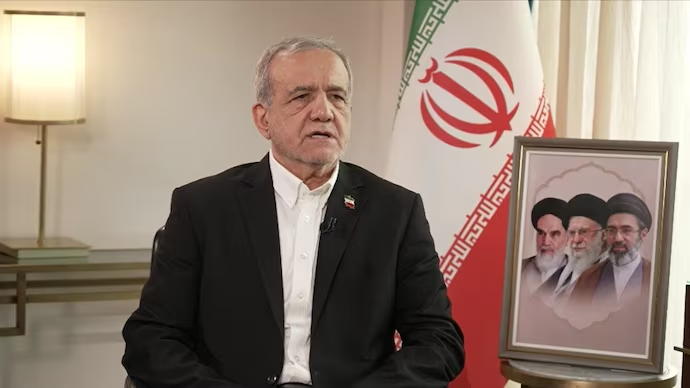
Iranian President Masoud Pezeshkian has signalled that Tehran is not prepared to back down under US pressure, particularly over the strategically important Strait of Hormuz.
Speaking to India Today during his visit to New Delhi for the BRICS Summit, Pezeshkian said Iran would continue responding if Washington tried to block the country’s routes. He also linked the reopening of Hormuz to an end to US pressure, including the naval blockade and sanctions.
1. Hormuz Becomes a Major Flashpoint
The Strait of Hormuz has become one of the most important pressure points in the continuing West Asia conflict. The waterway is a crucial route for global energy shipments, making any prolonged disruption a concern far beyond the region.
Iran’s position is that the route cannot return to normal while what Tehran describes as a US blockade remains in place. Pezeshkian has indicated that reopening the waterway would require Washington to change its approach towards Iran.
2. Pezeshkian Says Iran Will Not Surrender
Pezeshkian’s message was uncompromising: Iran does not intend to surrender because of external pressure.
He argued that Tehran would continue responding to actions it considers aggression. His comments underline the wider dispute between Iran and the US, where military pressure, sanctions and negotiations have become closely connected.
The Iranian president has also maintained that Tehran remains open to diplomacy if the conditions for negotiations change.
3. Oman Could Play a Role
Alongside his comments on the US, Pezeshkian pointed to discussions with Oman over a possible maritime framework for the Strait of Hormuz.
Oman has traditionally maintained diplomatic channels with both Iran and Western countries, making it an important intermediary in regional crises.
However, an Iranian source told Reuters on Saturday that a recent understanding with Oman does not mean the immediate reopening of Hormuz. Instead, it provides a possible framework for reopening in the future, subject to Tehran’s conditions.
4. Why India Is Watching Closely
Pezeshkian’s comments came during his India visit, where Iran’s relationship with New Delhi was also an important part of the diplomatic conversation.
India has major economic and energy interests connected to West Asia. Any prolonged disruption around Hormuz could affect shipping, fuel costs and broader trade routes.
At the BRICS Summit, India also pushed for dialogue and greater attention to maritime safety. The summit’s joint discussions reflected concern over the impact of the Middle East conflict on civilian infrastructure, global trade and energy flows.
5. BRICS Takes Up the Middle East Crisis
The timing of Pezeshkian’s visit was significant. The BRICS meeting in New Delhi brought together countries with different relationships with Washington and Tehran.
BRICS leaders expressed concern over the escalating Middle East conflict and criticised unilateral sanctions that lack UN Security Council approval. The group also called for protection of civilian infrastructure and nuclear safety during conflicts.
For Iran, the summit provided an opportunity to present its position directly to major emerging economies.
6. The Energy Risk Is Much Bigger Than Iran
The Hormuz dispute has implications well beyond Iran and the United States.
Oil tankers using the region face increased security concerns, while countries dependent on Gulf energy supplies have to monitor developments closely. Recent US decisions to limit air-defence coverage for commercial tankers travelling through Hormuz demonstrate the continuing difficulty of keeping the route secure.
Any extended disruption could therefore affect energy prices, shipping insurance and international trade.
7. What Happens Next?
The immediate future of Hormuz will depend on whether diplomatic channels can produce an arrangement acceptable to Iran, the United States and other regional players.
Pezeshkian’s comments suggest Tehran wants the lifting of pressure before considering a full return to normal maritime traffic. At the same time, negotiations involving Oman indicate that diplomatic options have not completely disappeared.
For India and other major trading economies, the priority will be restoring safe and predictable shipping. The coming weeks could determine whether Hormuz becomes a pathway towards de-escalation or remains one of the most dangerous pressure points in the global economy.