
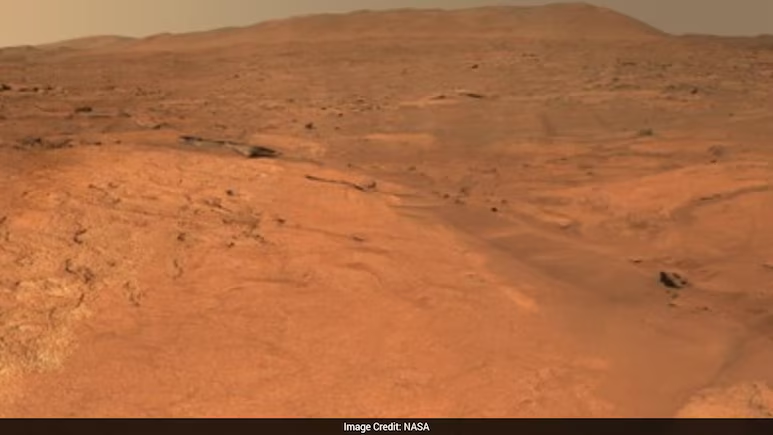
NASA’s Perseverance rover has uncovered a surprisingly detailed record of ancient water activity on Mars. While exploring the Margin Unit along the inner edge of Jezero Crater, the rover found igneous rocks that appear to have interacted with water several times in the distant past.
Unexpected Rocks at Jezero Crater
Scientists initially expected to find sedimentary rocks in the Margin Unit because the region lies along the shoreline of an ancient Martian lake. Instead, Perseverance discovered igneous rocks, which form from cooled magma.
These rocks have proved valuable because their mineral crystals can preserve information about the conditions under which they formed and later changed.
Water Left Multiple Traces
Analysis suggests that the rocks experienced at least three separate episodes of water interaction. Each event altered the minerals in different ways, giving scientists a more complex picture of Mars’ ancient environment.
The findings indicate that water was not limited to a single period of activity in this part of Jezero Crater.
Clues Hidden in Olivine
A key mineral in the rocks is olivine, which originally formed deep underground as magma cooled slowly. Over time, erosion exposed the rocks at the surface.
At lower elevations, scientists found that the olivine had been fractured and altered, with minerals including silica appearing between the grains. These changes point to later interaction with water.
Groundwater and Ancient Lake Water
Researchers identified evidence for different types of water activity. An early episode involved carbon-dioxide-rich groundwater reacting with the rocks and producing carbonate minerals.
A later interaction may have involved water from the ancient lake that once occupied Jezero Crater. Scientists also found evidence of a much later episode involving heated underground fluids.
Perseverance’s Laser Helps Read the Rocks
Much of the evidence came from SuperCam, an instrument mounted on Perseverance’s mast. It can fire a laser at rocks from a distance and analyse the resulting plasma to determine their chemical composition.
The rover has examined more than 185 bedrock targets across the Margin Unit using this technique.
What the Discovery Means for Mars
The findings provide scientists with new clues about how water moved through ancient Mars and how the planet’s rocks, atmosphere and surface environments changed over time.
Carbonates and silica are also important to astrobiologists because, on Earth, such minerals can preserve evidence of past biological activity. The new discovery does not establish that life existed on Mars, but it helps identify environments and rocks that could preserve clues about the planet’s ancient habitability.
As Perseverance continues exploring Jezero Crater, its observations could help scientists reconstruct a more detailed history of Mars’ water, climate and geological evolution.