
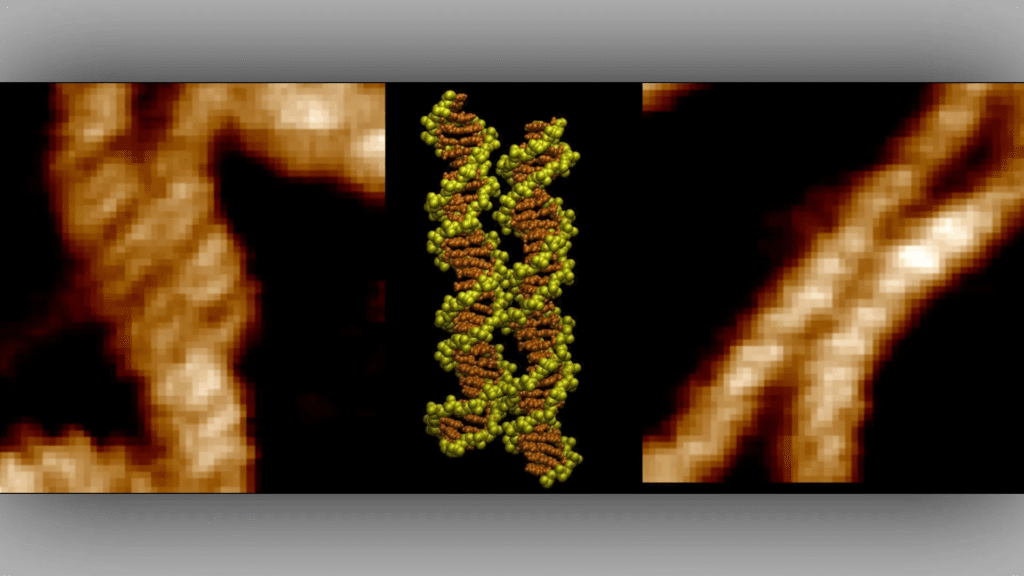
For decades, scientists have wondered how two DNA molecules can come close enough to recognise matching sequences even though DNA carries a negative electrical charge and should naturally repel another negatively charged molecule.
Researchers from the University of York and the University of Sheffield have now captured this interaction in detail, providing experimental support for a mechanism known as the DNA zipper model.
How DNA Overcomes Electrical Repulsion
DNA molecules normally repel one another because of their negative charges. Yet DNA pairing is important for several biological processes, including genetic recombination and gene regulation.
The new research suggests that positively charged metal ions help solve this problem. These ions can sit within the grooves of DNA and act as tiny molecular bridges, allowing two DNA molecules to align closely.
Scientists Capture the Molecular Interaction
The researchers used atomic force microscopy to observe short sections of DNA at extremely small scales. The technique produced detailed images showing how the molecules positioned themselves relative to each other.
Computer simulations were then used to study the movement of individual atoms and ions. Together, the imaging and simulations helped reveal the forces responsible for the interaction.
The DNA “Zipper” Theory Gets Experimental Support
The mechanism supports a theory proposed around two decades ago. According to the model, ions surrounding DNA create patterns of electrical charge that help neighbouring DNA molecules align.
The latest observations provide direct experimental evidence for this proposed mechanism, turning a long-standing theoretical idea into something scientists can examine more closely.
Not All DNA Sequences Behave the Same Way
An important finding was that some sections of DNA formed stronger contacts than others. These interaction hotspots could help scientists identify regions of the genome that are particularly involved in DNA recognition and pairing.
Such regions may become important for understanding what happens when mutations interfere with normal cellular processes.
Could This Help Cancer Research?
DNA recognition and pairing are involved in fundamental cellular processes, so understanding the molecular mechanism could have implications for biomedical research.
Scientists say that identifying genomic regions where these interactions are particularly strong could eventually help researchers investigate how certain mutations contribute to diseases such as cancer. The discovery does not itself provide a cancer treatment, but it offers a new piece of basic biological knowledge.
Potential Uses Beyond Biology
The discovery may also interest biotechnology researchers. If DNA sequences can be selected or designed to interact in predictable ways, scientists could potentially use these properties to construct customised DNA-based structures.
That could make the molecular “zipper” mechanism useful not only for understanding biology but also for future developments in DNA-based technology.
A Closer Look at DNA’s Hidden Behaviour
The study shows how advanced microscopy and computer modelling can reveal interactions that are almost impossible to observe directly.
By showing how tiny ions help DNA molecules overcome electrical repulsion and align with one another, researchers have provided a clearer picture of one of the fundamental molecular interactions inside living systems.