
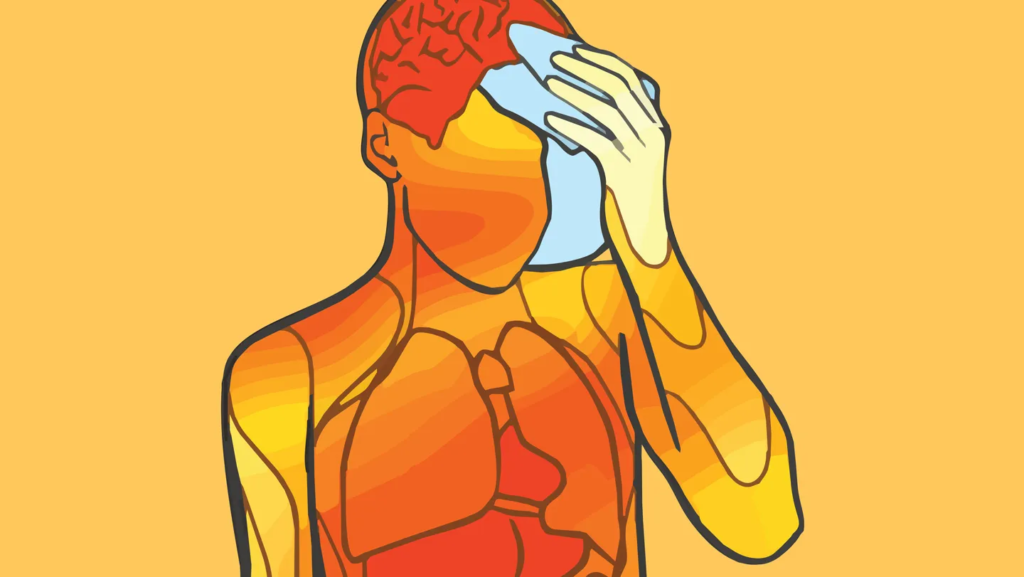
As heat waves become more frequent and intense, scientists are investigating an intriguing question: can the human body be trained to cope better with extreme temperatures? New research suggests that repeated, controlled exposure to heat can trigger several protective changes in the body.
The Body Has Its Own Heat-Adaptation System
When people are exposed to heat repeatedly, the body can gradually adjust. Sweating may begin earlier and become more effective, while blood vessels near the skin can widen faster, helping release excess heat.
The Brain Plays a Key Role
The hypothalamus, a region of the brain that helps regulate body temperature, appears to become more responsive after repeated heat exposure. It can trigger sweating and blood-vessel expansion more quickly, helping the body cool itself.
Heart and Blood Volume Also Adapt
Heat initially puts extra demands on the cardiovascular system. With continued exposure, however, blood volume can increase and the heart may not need to work as hard. Researchers have observed lower heart rates after heat-acclimation programmes.
Older Adults May Also Benefit
Scientists have traditionally studied heat adaptation in athletes, soldiers and outdoor workers. New research is examining whether older adults can develop similar responses, despite age-related declines in sweating and blood-vessel dilation.
In one seven-day study, both younger and older participants showed earlier sweating and blood-vessel responses after repeated warm-water exposure, along with modest reductions in body temperature and heart rate.
Heat Shock Proteins Offer Another Clue
The body’s response may extend down to the cellular level. Research in older men found increased concentrations of heat shock proteins following repeated hot-water immersion. These proteins help protect and repair cells under heat and other forms of stress.
But Heat Acclimation Has Limits
Being accustomed to hot weather does not make someone immune to heat illness. Even populations living in very hot regions have physiological limits, and researchers say acclimation can fade when regular heat exposure stops.
Could Heat Training Protect Vulnerable People?
Scientists are now exploring whether controlled heat-acclimation programmes could help older adults and other vulnerable groups prepare for heat waves. However, researchers stress that such experiments require careful medical supervision, particularly for people with heart disease or other health conditions.
A Possible Tool for a Hotter Future
As climate change increases the frequency of extreme heat, understanding the body’s natural ability to adapt could become increasingly important. Researchers are still determining how much exposure is useful and how safely it can be achieved, but the findings suggest that the human body may have more capacity for heat adaptation than previously appreciated.