
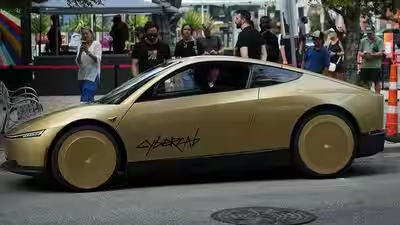
Tesla’s Cybercab is designed to look unlike a conventional car. There is no steering wheel, no accelerator or brake pedal and no traditional side mirrors. Instead, the vehicle is built around the idea that software and autonomous driving systems should handle the entire journey.
That futuristic approach is now facing a major regulatory test. The US National Highway Traffic Safety Administration (NHTSA) has opened an audit into how Tesla certified the Cybercab as meeting federal vehicle-safety requirements. The review covers an estimated 1,000 vehicles.
1. A Robotaxi Without Traditional Controls
The Cybercab is a two-seat autonomous vehicle created specifically for robotaxi use. Unlike Tesla models that still allow a human to take control, the new vehicle removes the hardware normally used by a driver.
Its design reflects Tesla’s larger ambition to move transportation towards fully autonomous mobility, where passengers become riders rather than drivers.
The company has already begun commercial deployment of Cybercabs in Austin, Texas, putting the technology directly into real-world use.
2. Why NHTSA Is Looking Closely
The regulator’s concern is not simply whether the Cybercab can drive itself. NHTSA is examining the process and technical information Tesla used when it certified the vehicle.
Under the US system, manufacturers generally certify that their vehicles comply with federal safety standards. Regulators can later investigate whether those certifications are valid.
NHTSA said the audit will examine whether Tesla considered certain safety requirements inapplicable because the Cybercab does not have conventional driver controls.
3. Old Rules Meet New Technology
The Cybercab highlights a difficult question for autonomous-vehicle developers: what happens when safety rules designed around human drivers meet cars that are not designed to have one?
Traditional regulations include requirements involving equipment such as brake pedals, lighting, windshield wipers and rearview mirrors. NHTSA itself says it is working on changes to accommodate automated vehicles, but those changes are not yet complete.
This creates a regulatory gap between how cars have traditionally been designed and how autonomous vehicles are beginning to operate.
4. Why Self-Certification Matters
Tesla’s approach is particularly significant because the company did not follow the same exemption route used by some other autonomous-vehicle developers.
Amazon-backed Zoox, for example, received a federal exemption in July for limited deployment of its own steering-wheel-free robotaxi. Tesla instead certified its Cybercab as compliant with applicable standards, making the NHTSA review especially important.
The outcome could therefore influence how future autonomous vehicles reach American roads.
5. The Bigger Challenge for Tesla
The Cybercab is more than another Tesla model. It is central to Elon Musk’s broader push into autonomous transportation, AI and robotics.
Tesla wants to expand robotaxi operations beyond the initial Austin deployment. That means regulatory uncertainty could become an important factor in determining how quickly the company can scale the service.
A favourable regulatory conclusion could make expansion easier, while a finding that additional compliance steps are required could slow the rollout.
6. A New Kind of Driving Experience
The Cybercab also represents a major change in how people could interact with vehicles.
Without a steering wheel or pedals, passengers cannot simply take over if they dislike the vehicle’s decision. The entire experience depends on the autonomous system making correct decisions, responding to unexpected situations and safely dealing with other road users.
Recent rides have already generated discussion about the practical realities of operating a completely driverless taxi, including route decisions and vehicle behaviour.
7. The Future of Driverless Cars May Depend on This Debate
Tesla’s Cybercab has turned an engineering experiment into a larger policy question: how should governments regulate cars that no longer fit the traditional definition of a car?
NHTSA has said it supports the development of automated vehicles while stressing that existing laws still have to be followed.
The Cybercab audit could therefore become an important moment for the entire autonomous-vehicle industry. If regulators find a workable path for vehicles without conventional controls, it could encourage faster development of purpose-built robotaxis.
For Tesla, however, the immediate challenge is proving that its vision of a car without a driver is not only technologically possible, but also legally and safely ready for the road.