
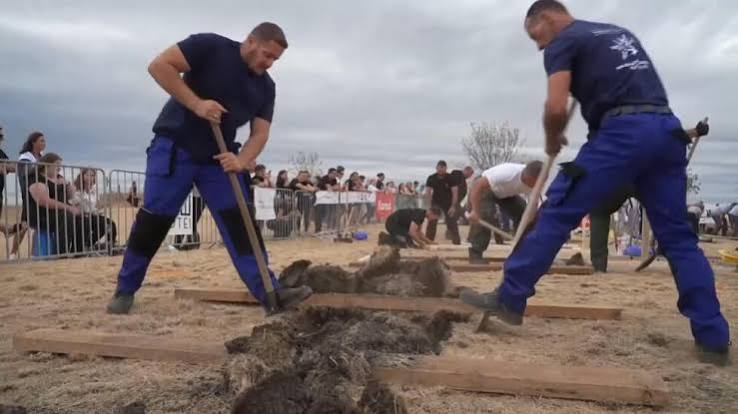
A cemetery in northern Hungary recently became the setting for an unusual competition where contestants swapped traditional sporting equipment for spades, shovels and pickaxes.
The event was a grave-digging contest designed to highlight the skill and physical demands involved in a profession that is rarely discussed outside funerals.
38 Competitors Take on the Challenge
The competition was held at a public cemetery in Nyergesújfalu, Hungary. Nineteen two-person teams, or 38 participants, took part in the unusual event.
Rather than simply digging as quickly as possible, participants had to meet strict requirements for the size and shape of the grave.
Precision Was Just as Important as Speed
Competitors had to dig a grave measuring 1.6 metres deep, 2 metres long and 0.8 metres wide.
The challenge required physical strength, coordination and accuracy. Participants used traditional hand tools while dealing with hard, dry soil.
The winning team completed its grave in 1 hour and 21 minutes.
Why Organise a Grave-Digging Competition?
The event was organised by the Hungarian Association of Cemetery Maintainers and Operators to showcase the professionalism and skills involved in grave digging.
Organisers also wanted to challenge some of the discomfort and taboos surrounding death-related work.
Although grave digging is generally associated with solemn occasions, it is also a specialised profession requiring experience and physical ability.
A Profession Rarely Seen in the Spotlight
Funeral workers and cemetery employees perform important tasks that are often invisible to the wider public. Preparing a grave requires more than simply removing soil.
The dimensions must be correct, the work area must be safe and the finished grave needs to be properly prepared for the funeral ceremony.
The competition offered an unusual opportunity to bring attention to those skills.
Winners Take Home a Cash Prize
The winning pair, Róbert Nagy and László Kiss, shared a prize of 200,000 Hungarian forints, equivalent to roughly $640.
Their performance demonstrated how experience and efficiency can make a significant difference when working under pressure.
Turning an Unusual Idea Into a Conversation
At first glance, a grave-digging contest may seem strange. But behind the unusual format is a practical purpose: recognising a profession that plays an essential role in communities.
By turning the spotlight on cemetery workers, the event also encourages people to look at death-related professions with greater understanding rather than discomfort.
The Hungarian competition therefore became more than a race. It was an unusual way of recognising the people whose work helps families during some of life’s most difficult moments.