
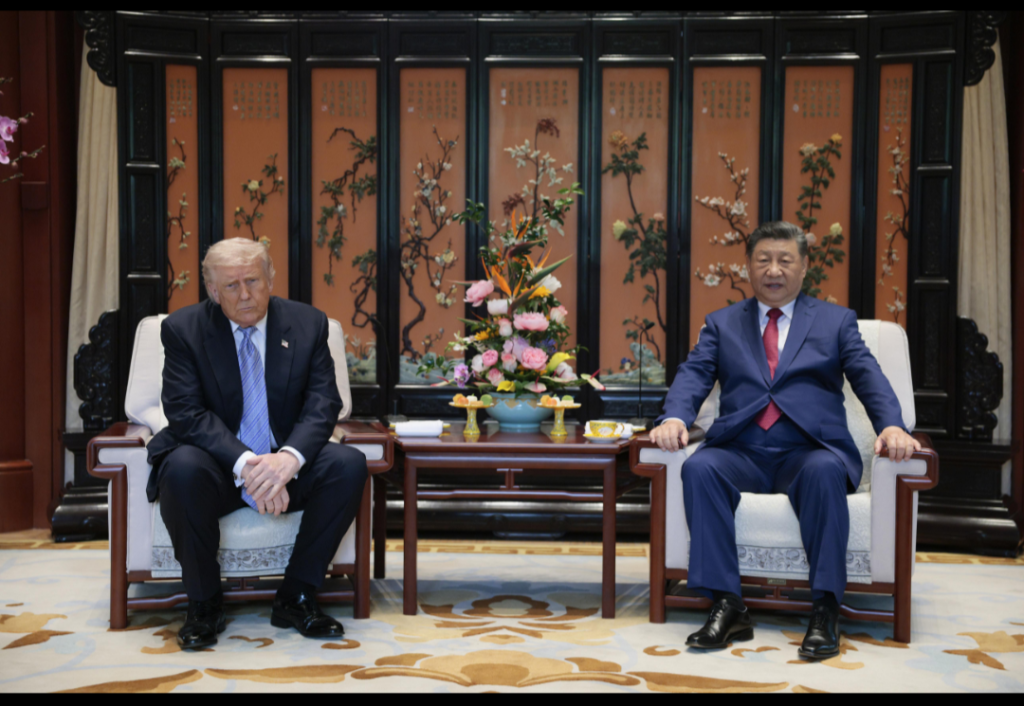
US and Chinese officials remain deeply engaged in trade discussions focused on tariffs, artificial intelligence, and critical minerals as President Donald Trump hosts Chinese President Xi Jinping for a high-profile state visit in Washington.
Xi arrived in the United States on September 23, 2026, for a three-day visit—his first trip to Washington in more than a decade and the first US visit in nearly three years. Trump personally welcomed him at Joint Base Andrews with a red-carpet ceremony, underscoring the significance of the meeting. Bilateral talks are scheduled at the White House on September 24.
A key early outcome is the extension of the existing US-China trade truce. US Treasury Secretary Scott Bessent announced that the two sides agreed to prolong the arrangement—originally set to expire on November 10—until January 10, 2027. The truce, reached in Busan, South Korea, last year, had capped certain US tariffs and secured Chinese commitments on rare earth supplies after a period of sharp escalation.
Bessent stated the extension provides more time to pursue a broader economic agreement. Officials are also working on reciprocal tariff reductions covering roughly $30 billion of goods on each side, focusing on non-sensitive or non-strategic products. Potential US exports under discussion include agricultural goods, energy, and medical devices, while Chinese exports could involve consumer and lower-tech items. Progress is also expected on Chinese purchases of US soybeans and Boeing aircraft, commitments that have advanced unevenly.
Access to critical minerals and rare-earth magnets remains a central friction point. China dominates global supply of these materials, which are essential for electric vehicles, semiconductors, defense systems, and AI hardware. US officials have said Beijing’s deliveries have not fully met earlier commitments, and the issue is high on the agenda. Stable flows are viewed as vital to preventing renewed supply-chain disruptions.
AI has emerged as a major new topic. The two sides discussed establishing a formal US-China AI dialogue or notification mechanism. This would allow communication on national-security-related incidents, shared risks, and potential guardrails for advanced models. Bessent described China as “very eager” to engage on the issue, though deep differences persist over export controls, technology competition, and regulatory approaches.
Preparatory talks in New York between Bessent, US Trade Representative Jamieson Greer, and Chinese Vice Premier He Lifeng laid the groundwork. Additional topics likely to surface during the leaders’ meeting include Taiwan, China’s ties with Iran, fentanyl precursors, and military-to-military dialogue. Analysts note low expectations for a comprehensive breakthrough, with both sides aiming primarily to stabilize the relationship and avoid renewed escalation.
The summit tests whether the fragile trade truce can evolve into more durable arrangements while managing strategic competition in technology and supply chains. Outcomes on tariffs, minerals, and AI cooperation will signal the near-term trajectory of the world’s most consequential bilateral economic relationship.