
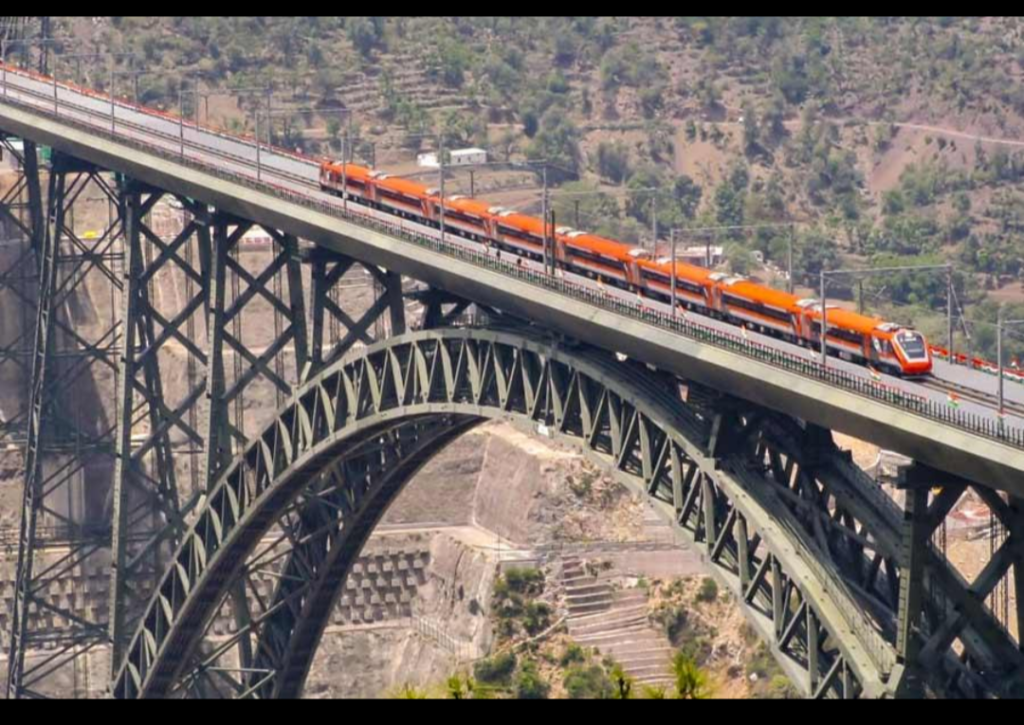
In a proud moment for Indian engineering and rail connectivity, the Jammu-Srinagar Vande Bharat Express successfully crossed the world’s highest railway arch bridge — the Chenab Bridge — and India’s first cable-stayed railway bridge, the Anji Khad Bridge, at 100 kmph on October 2, 2026.
This marked the first time a Vande Bharat train operated at the full revised speed of 100 kmph over these iconic structures on the strategically important Udhampur-Srinagar-Baramulla Rail Link (USBRL) project.
Indian Railways has increased the maximum permissible speed on the 111-km Shri Mata Vaishno Devi Katra–Banihal section from 75 kmph to 100 kmph.
The higher speed was successfully tested using Vande Bharat Express train numbers 26401/26404. Earlier, the permissible speed was 85 kmph on the Katra–Sangaldan stretch and 75 kmph between Sangaldan and Banihal.
Union Railway Minister Ashwini Vaishnaw shared a video of the run on X (formerly Twitter) with the caption:
“100 km/h over India’s engineering pride!”
He described the day as historic, noting that the speed enhancement will make train operations on the USBRL project smoother, reduce travel time, and offer passengers faster, safer, and more comfortable journeys.
Engineering Marvels: Chenab and Anji Bridges
World’s highest railway arch bridge
Height: 359 metres above the riverbed (about 35 metres taller than the Eiffel Tower)
Length: 1,315 metres
Main arch span: 467 metres
Designed to withstand wind speeds up to 260–266 kmph and seismic forces
Design life: 120 years
Located near Reasi in Jammu & Kashmir
India’s first cable-stayed railway bridge
Height: 331 metres above the riverbed
Total length: approximately 725 metres
Features a single 193-metre-high pylon supported by 96 high-tensile cables
These bridges form critical links on the challenging Himalayan terrain of the USBRL project, which provides all-weather rail connectivity between the Kashmir Valley and the rest of India.
The speed upgrade is expected to:
Reduce journey time between Katra and Banihal
Improve overall efficiency on the Jammu–Srinagar corridor
Boost tourism, trade, and economic activity in the region
Deliver a smoother and more comfortable travel experience
The Katra–Banihal section is one of the most technically demanding parts of the USBRL project, featuring numerous tunnels and bridges through the Pir Panjal and lower Himalayan ranges.
This successful high-speed run demonstrates the maturity of India’s modern rail infrastructure and the capabilities of the indigenous Vande Bharat trains in extreme terrain.