
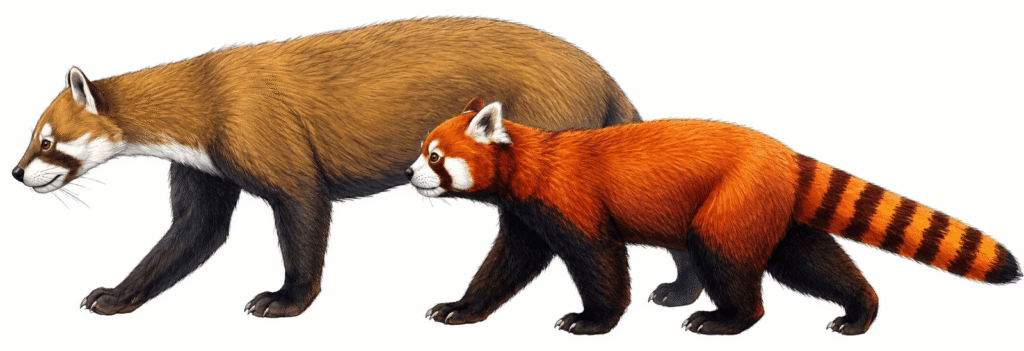
The red panda may look like a modern forest animal, but its evolutionary story stretches deep into Earth’s past. Its journey is part of a much larger history of life that began billions of years ago and gradually produced the extraordinary diversity of animals seen today.
How Life Began on Earth
Earth formed around 4.6 billion years ago, but life appeared much later. Scientists believe the earliest life forms emerged roughly 3.8 billion years ago, beginning with simple single-celled organisms.
Over immense periods of time, cells became more complex and eventually evolved into multicellular organisms. This opened the way for the development of increasingly diverse plants and animals.
The Cambrian Explosion Changed Life
One of the most important stages in evolutionary history was the Cambrian Explosion, around 540 million years ago. During this period, many major forms of animal life began appearing and diversifying rapidly, particularly in marine environments.
Later, vertebrates evolved and some lineages gradually adapted to life on land. These transitions eventually led to amphibians, reptiles, mammals and other major groups.
From Reptiles to Mammals
The evolution of amniotic eggs allowed some vertebrates to reproduce away from water, helping reptiles spread across terrestrial environments. Much later, one branch of the evolutionary tree produced mammals.
The disappearance of non-avian dinosaurs 66 million years ago also dramatically changed Earth’s ecosystems. With many ecological niches becoming available, mammals underwent major diversification.
Where Does the Red Panda Fit In?
The red panda belongs to the family Ailuridae and represents the only surviving member of that family. Its evolutionary history is distinct from that of the giant panda, despite the two animals sharing similar names and some dietary features.
Fossil evidence shows that ancient relatives of the red panda were once more widely distributed than the species is today. Over millions of years, evolutionary changes and environmental shifts shaped the lineage that eventually produced the modern red panda.
Why the Red Panda Matters
Today, red pandas are associated mainly with forest habitats in the eastern Himalayas and parts of southwestern China. Their restricted range makes them an important species for conservation.
The red panda’s story demonstrates that evolution is not a straight line. Species continually adapt to changing environments, while many branches disappear and only a few survive into the present.
A Living Link to Evolutionary History
From Earth’s earliest single-celled organisms to complex mammals, life’s history has been shaped by gradual change, extinction and adaptation. The red panda is one of the surviving branches of that enormous evolutionary tree a small animal carrying a remarkably deep history.