
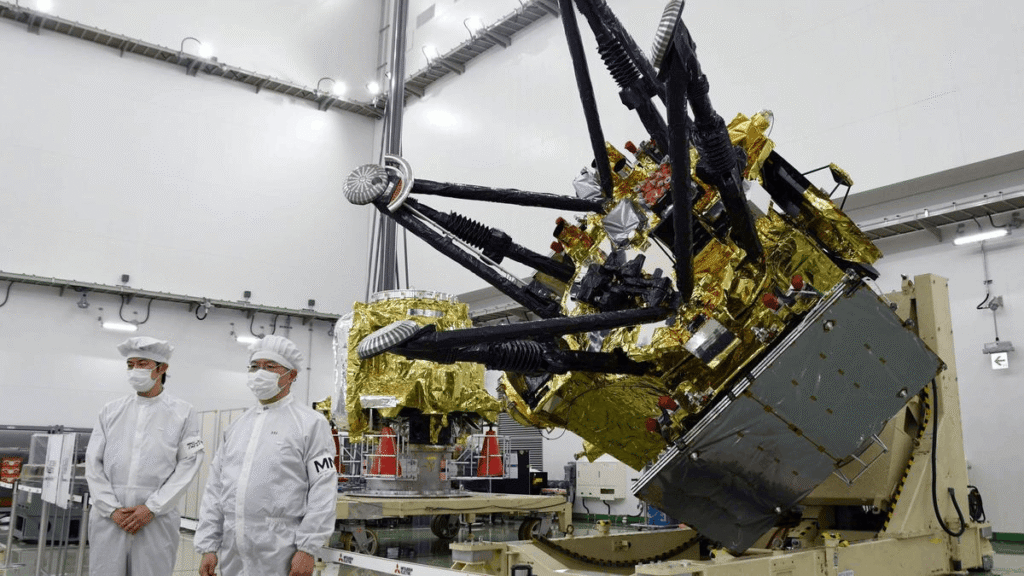
Japan is preparing to launch an ambitious space mission to explore Phobos, one of Mars’ two moons, and bring samples of its surface back to Earth. The Martian Moons eXploration (MMX) mission, led by the Japan Aerospace Exploration Agency (JAXA), is scheduled to launch on October 20, 2026, aboard Japan’s H3 rocket.
The mission aims to collect at least 10 grams of material from Phobos and return it to Earth in 2031. Scientists hope the samples will help explain how Mars’ moons formed and provide new insights into the history of the Red Planet and the early Solar System.
Why Is Japan Exploring Phobos?
Mars has two small moons, Phobos and Deimos, whose origins remain uncertain. Scientists have two leading explanations for their formation: they may be remnants of a large collision involving Mars, or they may be asteroids captured by the planet’s gravity.
Phobos is particularly important because it orbits relatively close to Mars. Its surface may contain material from the moon itself as well as tiny amounts of debris originating from Mars, offering researchers an opportunity to investigate the planet’s past.
How the MMX Mission Will Work
The mission is designed to last approximately five years, combining detailed observations of the Martian moons with a sample-return operation.
- Launch in 2026: The spacecraft will depart from Japan’s Tanegashima Space Center aboard an H3 rocket.
- Arrival in 2027: After a journey of about a year, MMX is expected to reach the Mars system and begin studying Phobos and Deimos.
- Surface exploration: The spacecraft will examine Phobos and identify a suitable landing site. The Idefix rover, developed by France and Germany, will help investigate the moon’s surface.
- Sample collection: MMX aims to collect at least 10 grams of material from Phobos through landing and sampling operations.
- Return to Earth in 2031: A protected capsule carrying the samples is scheduled to return to Earth, with recovery planned in Australia.
What Scientists Hope to Discover
One of the mission’s biggest goals is to determine whether Phobos formed from debris created by a massive impact on Mars or was captured from elsewhere in the Solar System.
Analysing samples directly in laboratories on Earth could provide more detailed information about the moon’s minerals, chemical composition and history than remote observations alone.
Scientists will also look for traces of material ejected from Mars by ancient impacts. Such evidence could help researchers better understand the geological evolution of Mars and its surrounding moons.
An International Effort to Explore Mars’ Moons
Although JAXA leads the MMX mission, several international space agencies are contributing instruments and technical support. NASA is providing scientific equipment, while the European Space Agency, France’s CNES and Germany’s DLR are also involved.
The spacecraft will carry instruments to study the moons’ surface, composition, gravity and environment. It will also attempt observations of Deimos, extending the mission’s scientific reach beyond Phobos.
Why the MMX Mission Matters
Returning samples from Phobos would be a major milestone in planetary exploration. The findings could help resolve longstanding questions about the origins of Mars’ moons and the processes that shaped the early Solar System.The mission will also test technologies needed for future journeys to the Martian system, including landing on small celestial bodies, collecting samples in extremely low gravity and transporting material across deep space.
If successful, MMX could give scientists a new way to investigate Mars’ history and prepare for more ambitious exploration missions in the years ahead.