
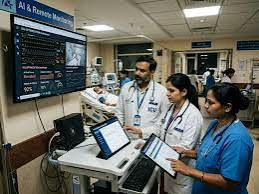
Artificial intelligence is moving beyond administrative tasks in healthcare and increasingly being explored for clinical and patient-care applications. In India, some of the most promising opportunities could involve intensive care, remote monitoring and support for patients outside hospitals.
AI Could Give ICUs an Extra Layer of Support
Intensive care requires doctors and nurses to monitor several vital parameters at once. AI-powered systems can analyse continuous patient data and flag unusual changes, potentially helping medical teams identify deterioration earlier.
Predicting Problems Before They Become Emergencies
One of AI’s biggest healthcare possibilities is predictive monitoring. Algorithms can analyse trends in vital signs and other clinical information to identify patients who may be heading towards complications such as sepsis or respiratory problems.
Remote Care Could Reach More Patients
AI could also strengthen remote healthcare by helping doctors monitor patients outside hospitals. Wearables and connected devices can collect information such as heart rate, blood pressure, glucose levels and oxygen saturation, allowing healthcare teams to follow patients from a distance.
Supporting Patients With Chronic Diseases
People living with conditions such as diabetes, hypertension and heart disease often require regular monitoring. AI-powered systems could identify changes in health data and alert medical teams when additional attention may be required.
Tele-ICU Could Help Bridge Specialist Gaps
Remote critical-care systems can connect smaller hospitals with specialist teams located elsewhere. Combined with AI-based monitoring, such models could help extend critical-care expertise to areas where specialist availability is limited.
Doctors Still Remain at the Centre
AI is expected to support rather than replace medical professionals. Its role can include analysing large volumes of information, prioritising alerts and reducing routine workloads, while doctors remain responsible for clinical decisions.
Challenges India Must Address
Successful AI adoption will require reliable digital health records, secure data systems and strong clinical oversight. Electronic medical-record adoption remains an important infrastructure challenge, while hospitals also need to ensure that AI tools fit naturally into existing medical workflows.
The Future of AI-Powered Healthcare
India’s next phase of healthcare AI could move from experiments to practical applications that improve monitoring and access to care. If implemented responsibly, AI could help hospitals manage resources more efficiently while giving patients greater access to continuous healthcare support.