
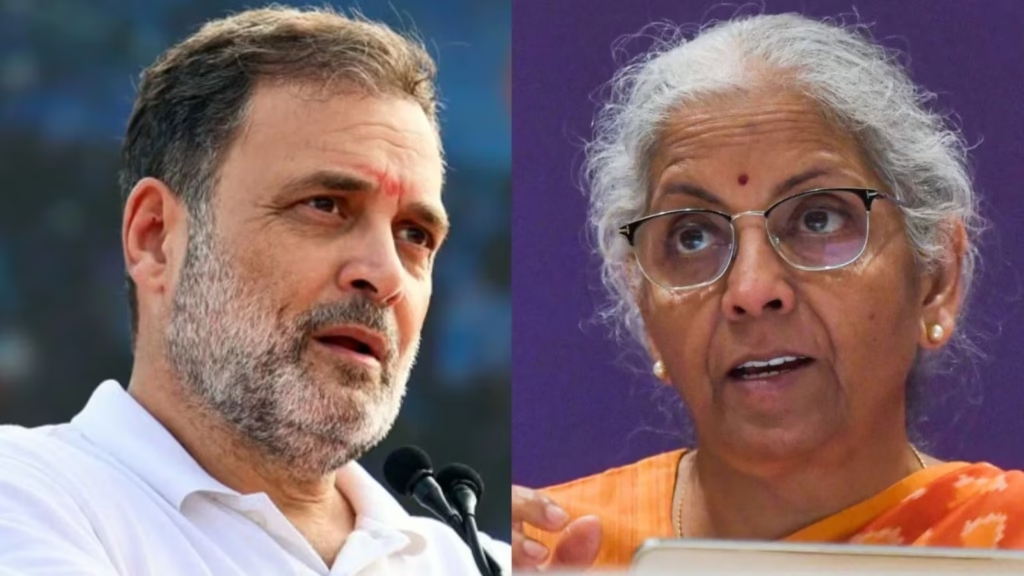
The Finance Minister defends the proposed transaction as the Congress leader raises concerns about public ownership and employees
Disinvestment becomes a political issue
The proposed sale of a majority stake in IDBI Bank has prompted a public exchange between Finance Minister Nirmala Sitharaman and Congress leader Rahul Gandhi. Sitharaman defended the government’s approach and criticised the record of earlier Congress-led governments, while Gandhi questioned the implications of the proposed change in ownership.
Rahul Gandhi highlights public-sector concerns
Gandhi has supported IDBI Bank employees opposing the proposed transaction. In an open letter, he argued that public-sector banks were built using public money and should continue contributing to national development. He also raised questions about the possible effect on employees, depositors and reservation-related protections.
Sitharaman raises historical examples
Responding to the criticism, Sitharaman alleged that Congress-led governments had interfered in public-sector lending decisions. She referred to the 1976 removal of former State Bank of India chairman R. K. Talwar, saying it followed his refusal to relax lending conditions for a company linked to Sanjay Gandhi’s circle. This is the Finance Minister’s account of the episode.
Bad loans and financial support cited
Sitharaman also referred to lending exposures involving business groups including Videocon, Winsome, ABG Shipyard and Kingfisher. She said some loans became non-performing assets and contributed to IDBI Bank’s financial difficulties. She credited the NDA government with providing more than Rs 25,000 crore in recapitalisation support and changing management and lending practices.
Proposed stake transfer and approvals
The government has approved a proposed sale of a combined 60.72 per cent stake in IDBI Bank to Canada-based Fairfax Financial Holdings for around Rs 53,000 crore. The proposed transaction includes the government’s 30.48 per cent holding and LIC’s 30.24 per cent stake. It remains subject to required regulatory approvals, including clearance from the Reserve Bank of India.
Employees and public ownership remain in focus
Gandhi has questioned whether the transaction could affect employees’ service conditions and the bank’s public-sector character. The employees’ association has also called for transparency. The government has defended the proposed sale, while Congress continues to question its consequences for workers and the public.