
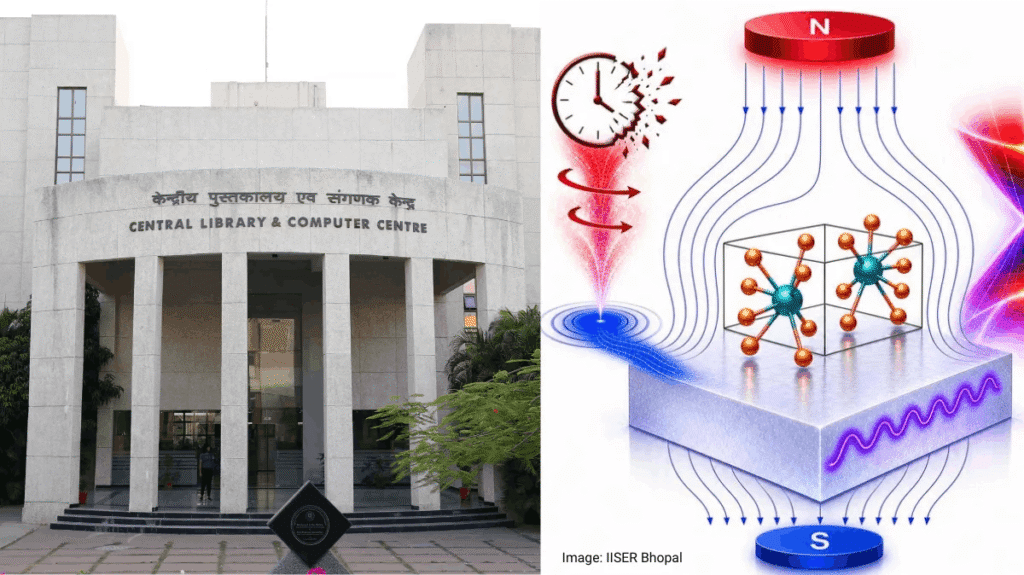
Scientists from the Indian Institute of Science Education and Research (IISER) Bhopal, along with researchers from IIT Kanpur and the ISIS Neutron and Muon Source, have found evidence of an unusual quantum behaviour in a Type-I superconductor.
The material, known as YbSb₂, appears to break a symmetry called time-reversal symmetry after entering its superconducting state. The finding could provide new opportunities for studying unconventional superconductivity and the relationship between superconductivity, magnetism and topology.
What Is Time-Reversal Symmetry?
Time-reversal symmetry is a concept in physics that describes whether a physical system behaves in the same way when the direction of time is mathematically reversed.
When this symmetry is broken, the system can show different physical behaviour under the reversed-time description. In superconductors, detecting this effect can provide clues about the nature of the superconducting state.
Why YbSb₂ Is Interesting
Type-I superconductors are generally considered a simpler class of superconducting materials. Unusual phenomena involving time-reversal symmetry breaking are more commonly discussed in unconventional superconductors.
The IISER Bhopal researchers found evidence that YbSb₂ combines Type-I superconductivity with broken time-reversal symmetry, making it an unusual system for further investigation.
Scientists Detected Tiny Internal Magnetic Fields
The research team used zero-field muon spin relaxation/rotation (μSR) measurements to investigate the material.
After YbSb₂ entered its superconducting state, the researchers observed evidence of spontaneous internal magnetic fields even without an externally applied magnetic field. This observation supports the presence of time-reversal symmetry breaking.
A Link Between Superconductivity and Topology
The study also points to an unusual electronic structure in YbSb₂. First-principles calculations indicate that the material is a Z₂ topological metal, with a Dirac nodal line close to the Fermi level.
This combination gives scientists another reason to investigate the material as they try to understand how superconductivity can emerge alongside topological electronic properties.
Could It Help Quantum Research?
Researchers are interested in materials with unusual superconducting and topological properties because they may help scientists explore exotic quantum states.
Such research has also been linked more broadly to the study of Majorana modes and possible future applications in quantum computing. However, the current findings are primarily important as a platform for understanding fundamental superconducting physics rather than as a demonstrated quantum-computing technology.
Why the Discovery Matters
The YbSb₂ findings challenge the simple distinction between conventional Type-I superconductors and systems displaying more unusual quantum behaviour.
For scientists, the material offers an opportunity to investigate how superconductivity, magnetic effects and topology interact. Further research will be needed to determine the precise mechanism behind the observed symmetry breaking and its broader implications.
The study therefore adds an intriguing new chapter to India’s growing contribution to research in quantum materials and condensed-matter physics.