
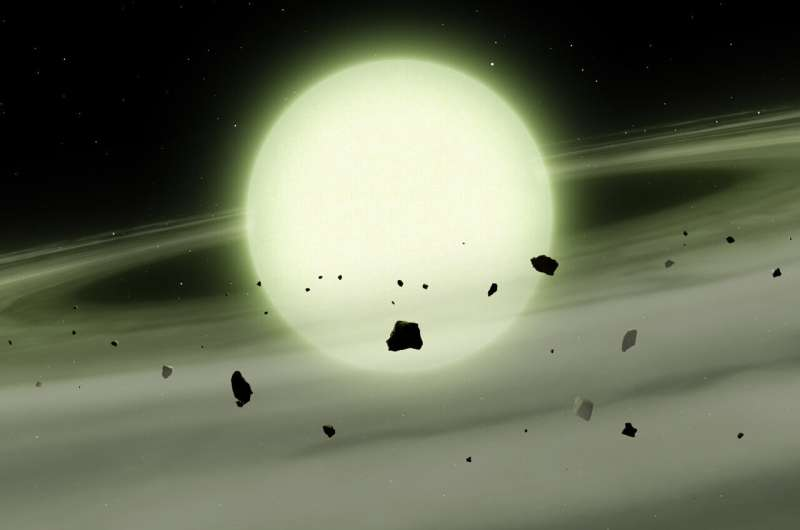
Astronomers have discovered that some white dwarf stars may appear in unexpected colours, including green, pink, purple and cyan. A study led by researchers at the University of Warwick challenges the common assumption that these stellar remnants should look only white or blue.
Published in RAS Techniques and Instruments in October 2026, the research shows how the unusual density and chemical composition of white dwarf atmospheres can change the colours of light they emit.
1. What Are White Dwarf Stars?
White dwarfs are the extremely dense remnants left behind when stars similar to our Sun reach the end of their lives. After a star exhausts its nuclear fuel and sheds its outer layers, its remaining core can become a white dwarf.
Although these objects are roughly Earth-sized, they contain a tremendous amount of mass. Their extreme physical conditions make them valuable subjects for studying stellar evolution and the final stages of a star’s life.
2. Why Can White Dwarfs Have Different Colours?
For most stars, colour provides clues about surface temperature. However, researchers found that temperature alone does not fully explain the appearance of certain white dwarfs.
Their atmospheres can be so dense that elements such as carbon, sodium and calcium interact with light in unusual ways. These interactions change which wavelengths are absorbed and which reach an observer, creating colours that differ from the familiar white and blue associated with many white dwarfs.
3. Scientists Identify a Green-Appearing Star
One of the study’s most striking examples is WDJ1330+6435, a relatively cool white dwarf with a temperature of approximately 4,000 degrees Celsius. Researchers calculated that it would appear greenish to human vision.
The star has accumulated rocky material from its former planetary system, enriching its atmosphere with elements including sodium. Under the extreme conditions in its atmosphere, sodium absorbs light across broad portions of the yellow, orange and red spectrum, leaving a greenish appearance in the researchers’ model.
The team describes it as the first credible example of a star that would genuinely appear green to the human eye.
4. How Some White Dwarfs Become Pink or Purple
The study also identified white dwarfs whose predicted colours fall into pink and purple shades. These appearances are linked to carbon-rich atmospheres and the formation of carbon molecules.
In some cool white dwarfs, convection brings carbon from deeper inside the star towards its surface. The resulting molecules absorb light across several visible wavelengths, changing the overall colour perceived by an observer.
Other white dwarfs may appear yellow or cyan depending on their atmospheric composition and physical conditions.
5. How Astronomers Calculated the Colours
The stars are too distant for their colours to be observed directly in the way the study describes. Instead, researchers analysed stellar spectra, which record how much light a star emits at different wavelengths.
They then used models of human colour vision to estimate how the light would appear to the naked eye. This approach allowed the team to investigate colours that might otherwise be overlooked when studying stars through their spectra alone.
The method also demonstrates how chemical information can help scientists understand the visual appearance of distant celestial objects.
6. What Did the Study Find About Nearby White Dwarfs?
The researchers examined a representative sample of 151 white dwarfs located within approximately 20 parsecs, or 65 light-years, of Earth. Five showed unusual predicted colours: two yellow and three pink.
The sample suggests that unusually coloured white dwarfs are uncommon, but not exceptionally rare. The researchers estimated that around one in 30 white dwarfs across the wider population could display an unusual hue.
The study also found that the typical white dwarf in the sample would still appear white, challenging the impression that these stellar remnants are generally blue.
7. Why This Discovery Matters
The research highlights how the chemistry and density of a star’s atmosphere can reveal details that temperature alone cannot explain. It also shows how existing astronomical observations can be used to investigate new questions about stellar composition and evolution.
Although the green, pink and purple appearances are model-based predictions rather than colours directly seen from nearby stars, they offer a fresh way to understand these ancient stellar remnants.
The findings are a reminder that the universe can be more visually diverse than familiar astronomical descriptions suggest, even among objects once assumed to follow relatively simple colour rules.