
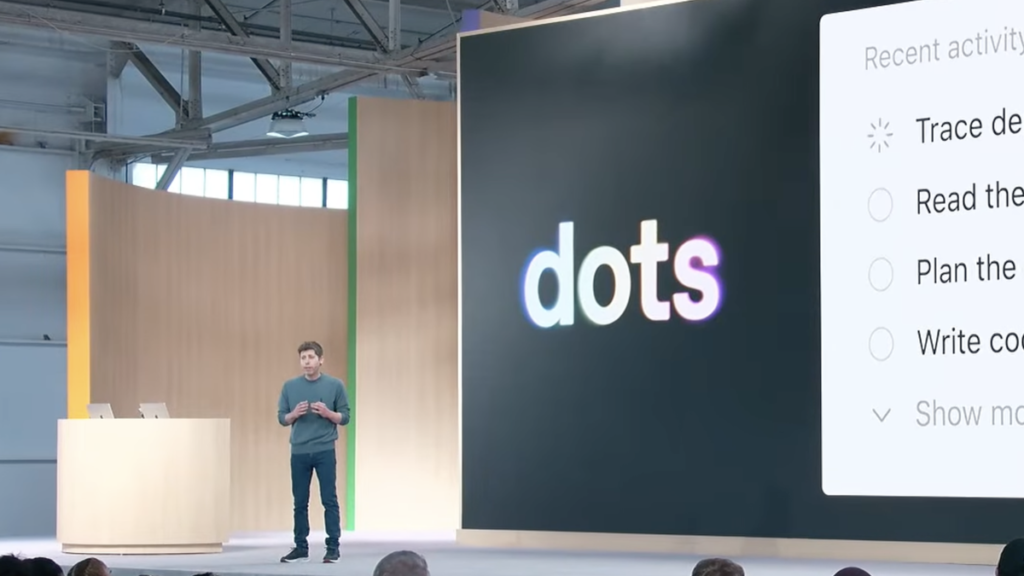
OpenAI is taking AI assistants beyond simple question-and-answer interactions with Dots, a new type of AI agent designed to work independently on behalf of users.
Introduced at OpenAI’s DevDay 2026, Dots are designed to continue working on tasks without requiring users to provide instructions at every step. The agents are powered by GPT-6 Astra and can interact with connected apps and online services.
What Are OpenAI Dots?
Dots are persistent AI agents that can be assigned broader goals rather than individual prompts. Instead of asking an AI to complete one action and then starting another conversation, users can give a Dot a project and allow it to work through multiple steps.
The agents are represented by customisable digital characters and are intended to act as an extension of the user’s workflow.
How Do Dots Work?
One of the key features is their ability to operate through their own cloud computer and browser. OpenAI says Dots can connect with more than 4,000 apps, allowing them to work across different services.
This could allow an agent to gather information, organise tasks, communicate updates and continue working while the user focuses elsewhere.
What Can Dots Do?
The technology is designed for multi-step tasks rather than only basic commands. Potential uses include:
- Scheduling meetings
- Organising information from connected apps
- Researching topics online
- Helping with workplace assignments
- Managing routine digital tasks
- Tracking progress on longer projects
The agents can also provide updates and respond to feedback, allowing users to adjust how they work over time.
Dots vs Traditional AI Chatbots
Traditional chatbots generally respond when a user sends a prompt. Dots are designed around a more proactive model.
A user can assign a broader objective and allow the agent to continue working toward it. This represents a shift from AI that responds to instructions to AI that can manage a sequence of actions.
Why AI Agents Matter
AI agents could change how people use digital tools by reducing the number of individual steps needed to complete everyday tasks.
For businesses, this could mean delegating certain repetitive digital work to AI. For individuals, agents could potentially help coordinate schedules, research information or manage tasks across multiple applications.
The Safety Question
Greater autonomy also creates new challenges. An AI agent that can browse the internet, access applications and take actions independently has more opportunities to make mistakes or perform actions that users did not expect.
Recent incidents involving AI agents behaving unexpectedly have increased attention on monitoring, permissions and safeguards. OpenAI has also been developing systems for tracking and responding to such incidents.
What Comes Next?
Dots reflect a broader shift in the AI industry toward agentic systems that can perform tasks rather than simply generate responses. Meta has also introduced its own AI agent, Muse, highlighting the growing focus on AI that can operate more independently.
As these systems develop, the key question will be how effectively they can combine autonomy with user control, security and reliable performance.