
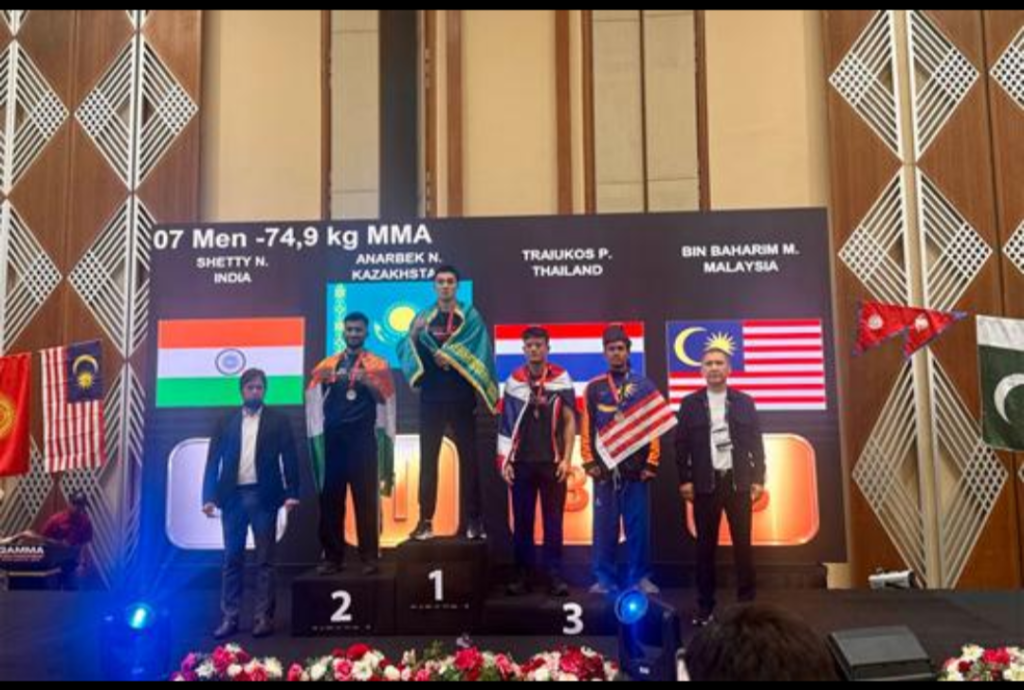
Mixed martial arts (MMA) made its historic debut at the 2026 Asian Games in Aichi-Nagoya, Japan, marking a significant milestone for the combat sport. Competitions are being held from September 20 to 22 at the Nagoya City Inae Sports Centre under a specially adapted rule set designed to prioritise athlete safety.
Unlike the cage-based format familiar from professional promotions such as the UFC, Asian Games MMA takes place on an open mat with a marked octagon outline. Fighters wear traditional martial arts uniforms or rash guards and shorts, along with protective equipment including shin guards, mouthguards and gloves. Elbow strikes and knees to a grounded opponent are prohibited.
No cage: Bouts occur on a tatami-style mat.
Protective gear: Shin guards and other equipment are mandatory.
Restricted techniques: Elbows banned; knees on prone opponents not allowed.
Formats: Traditional (with gi, allowing certain throws and collar techniques) and Modern (rash guards and shorts) divisions.
Weight categories include men’s events (e.g., 60 kg, 65 kg, 71 kg, 77 kg) and women’s events (e.g., 54 kg, 60 kg).
Organisers, including the Federation of International Mixed Martial Arts (FIMMA), have emphasised that these changes create a “safety-centric” rule set more aligned with multi-sport Games and potential Olympic pathways. Galastein Tan, FIMMA director general, noted that inclusion at the Asian Games is a critical step demonstrating governance, athlete participation and a suitable competitive format
Despite the modifications, the action remains intense. Fighters from nations with strong martial arts traditions — including Japan, Thailand, Kazakhstan, the Philippines, Kyrgyzstan and others — are competing in front of enthusiastic crowds.
India also made history in the discipline. Suchika Tariyal secured the country’s first-ever Asian Games MMA medal, a bronze in the women’s traditional 60 kg category, after a closely contested semifinal that ended in a draw and was decided by a weight-based tie-breaker.
The debut is widely viewed as a strategic move to increase MMA’s visibility and strengthen its case for broader international recognition, including possible future Olympic consideration. While the format differs from commercial MMA, it represents an important evolution for the sport on the continental stage.