
Dumbbells are among the most versatile pieces of equipment for home workouts. They can help beginners build strength and allow experienced exercisers to work on muscle growth, endurance and overall fitness without needing a fully equipped gym.
With different weights, materials and designs available, choosing the right dumbbells depends on your fitness goals, experience level, available space and budget.
1. Fixed-Weight Dumbbells for Everyday Training
Fixed-weight dumbbells come in a set weight and are ready to use without adjustments. They are suitable for exercises such as bicep curls, shoulder presses, lunges and rows.
Beginners may prefer lighter weights, while people with more strength-training experience can choose heavier options. However, building a collection of fixed dumbbells may require additional storage space and investment.
2. Adjustable Dumbbells for Small Spaces
Adjustable dumbbells allow users to change the weight using interchangeable plates or a built-in adjustment mechanism. This makes them useful for people who want several resistance levels without storing multiple pairs.
They can be particularly practical for home gyms, although users should check the locking mechanism, ease of adjustment and overall stability before purchasing.
3. Rubber-Coated and Neoprene Options
The material covering a dumbbell can influence grip, comfort, durability and floor protection.
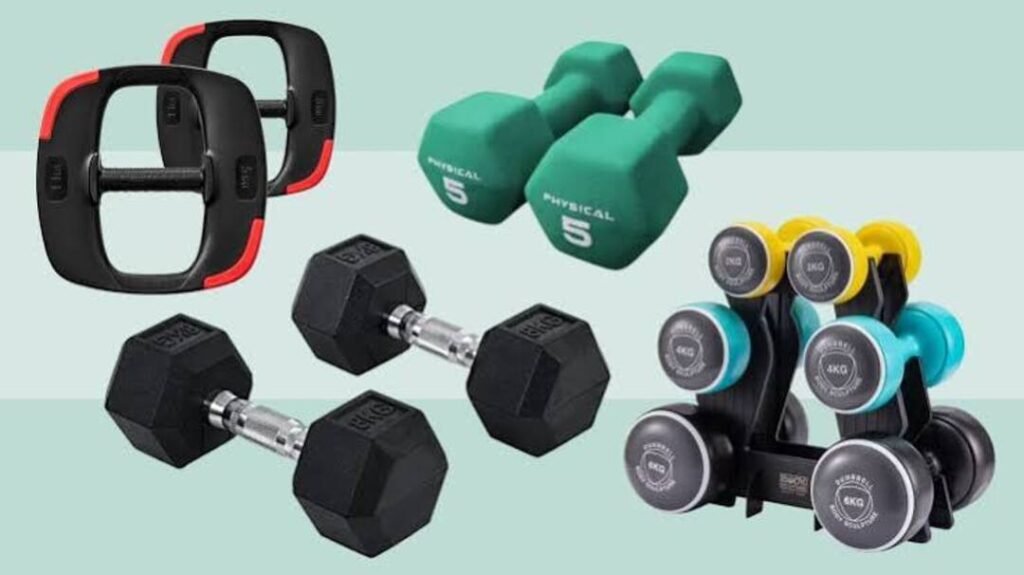
Rubber-coated dumbbells are popular for strength training, while neoprene-coated options often provide a comfortable grip and are available in lighter weights. These lighter models can be useful for beginners and certain high-repetition exercises.
4. Choose the Right Weight for Your Fitness Level
The ideal dumbbell weight depends on the exercise and your current strength. A weight suitable for lower-body exercises may be too heavy for shoulder raises or other smaller-muscle movements.
Choose a resistance that allows you to maintain proper technique throughout your set. If you struggle to control the movement, reduce the weight. As exercises become easier, increase resistance gradually.
5. Check Grip, Design and Storage
Before buying dumbbells, consider the handle’s comfort, the quality of the materials and whether the weights remain stable during use. Hexagonal dumbbells, for example, have flat sides that help prevent them from rolling away.
People with limited space may prefer compact adjustable sets. Those who frequently switch between exercises may find fixed-weight pairs more convenient.
6. Exercises You Can Do With Dumbbells
A pair of dumbbells can support a wide range of exercises, including:
- Bicep curls: Target the muscles at the front of the upper arms.
- Shoulder presses: Strengthen the shoulders and supporting muscles.
- Dumbbell rows: Work the back and arms.
- Goblet squats: Train the legs and glutes.
- Lunges: Challenge lower-body strength and balance.
- Floor presses: Work the chest, shoulders and triceps.
Beginners should learn the correct technique before increasing weight and allow adequate recovery between demanding sessions.
The Bottom Line
The best dumbbells are those that match your training needs, budget and available space. Fixed-weight options offer simplicity, while adjustable designs provide flexibility for home workouts.
Rather than choosing weights based only on their maximum load or appearance, prioritise a secure grip, reliable construction and resistance you can control safely. A well-chosen set can make strength training more accessible and help you build a consistent exercise routine.