
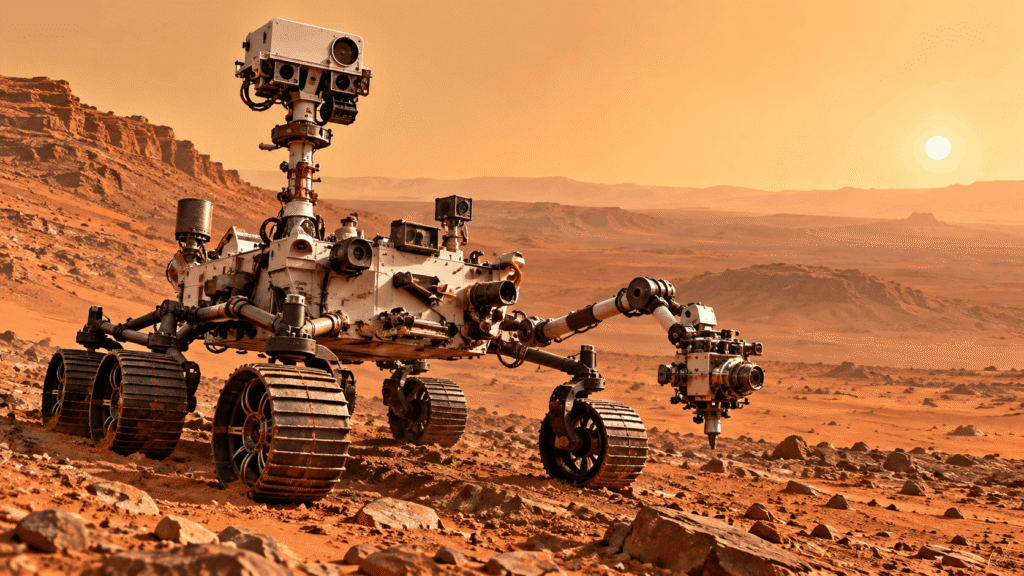
NASA’s Perseverance rover has set a new record for the longest distance driven by a vehicle on another world. The six-wheeled robotic explorer has travelled 28.10 miles (45.22 kilometres) across Mars, surpassing a record held by NASA’s Opportunity rover for years.
The milestone highlights advances in autonomous navigation and gives scientists access to more of the Red Planet’s ancient terrain.
1. Perseverance Surpasses Opportunity’s Record
Perseverance crossed the record distance on October 11, 2026, during its 2,006th Martian day, or sol, on the planet. It exceeded the previous record of 28.06 miles (45.16 kilometres), set by Opportunity during its mission from 2004 to 2018.
Perseverance achieved the feat in around five and a half years, while Opportunity operated on Mars for nearly 15 years. The new milestone reflects improvements in rover mobility, navigation and mission planning.
2. How Autonomous Navigation Helps the Rover
One of Perseverance’s biggest advantages is its AutoNav system. The technology allows the rover to analyse the terrain, identify obstacles and select a safe route between destinations chosen by its team on Earth.
NASA says AutoNav has supported more than 90% of Perseverance’s total driving distance. The system processes around 600,000 measurement points with each assessment of the terrain, helping the rover navigate rocky and uneven surfaces.
This capability reduces the need for constant, detailed driving instructions from Earth and allows the rover to cover more ground efficiently.
3. Exploring Mars’ Ancient Jezero Crater
Perseverance landed in Jezero Crater in February 2021. Scientists believe the region once contained a lake and river delta, making it a promising location to investigate whether Mars could have supported microbial life in the distant past.
The rover is now exploring terrain near the crater’s western rim, including an area known as Lac de Charmes, as it travels towards a location called Idubi. Researchers hope to find geological evidence of ancient hydrothermal systems, where hot water may once have interacted with Martian rocks.
4. Searching for Clues to Ancient Life
The rover’s mission extends beyond setting driving records. It collects rock and soil samples, studies mineral formations and examines environments that may preserve evidence of Mars’ early history.
One notable finding involved a rock nicknamed Cheyava Falls, which contained features identified as potential biosignatures. Such clues may be consistent with past biological activity, but they do not independently confirm that life existed on Mars.
By reaching a wider variety of geological formations, Perseverance can help scientists build a more complete picture of the planet’s ancient environment.
5. Mission Expected to Continue Through 2028
NASA has approved an extension of the Perseverance mission, allowing exploration of the Jezero Crater rim to continue through approximately the end of 2028.
The rover’s mobility systems remain operational, and its team expects it to add to its distance record. Longer drives can help scientists investigate more locations and examine a greater range of Martian rocks.
6. Why the Record Matters for Space Exploration
Perseverance’s achievement demonstrates how autonomous systems can improve robotic exploration far beyond Earth. Better route planning and obstacle detection allow spacecraft to operate more efficiently in environments where direct human control is difficult because of communication delays.
The rover’s growing travel distance also expands the area available for scientific investigation. Its findings could help researchers understand Mars’ geological evolution, assess its past habitability and prepare for future missions to the Red Planet.